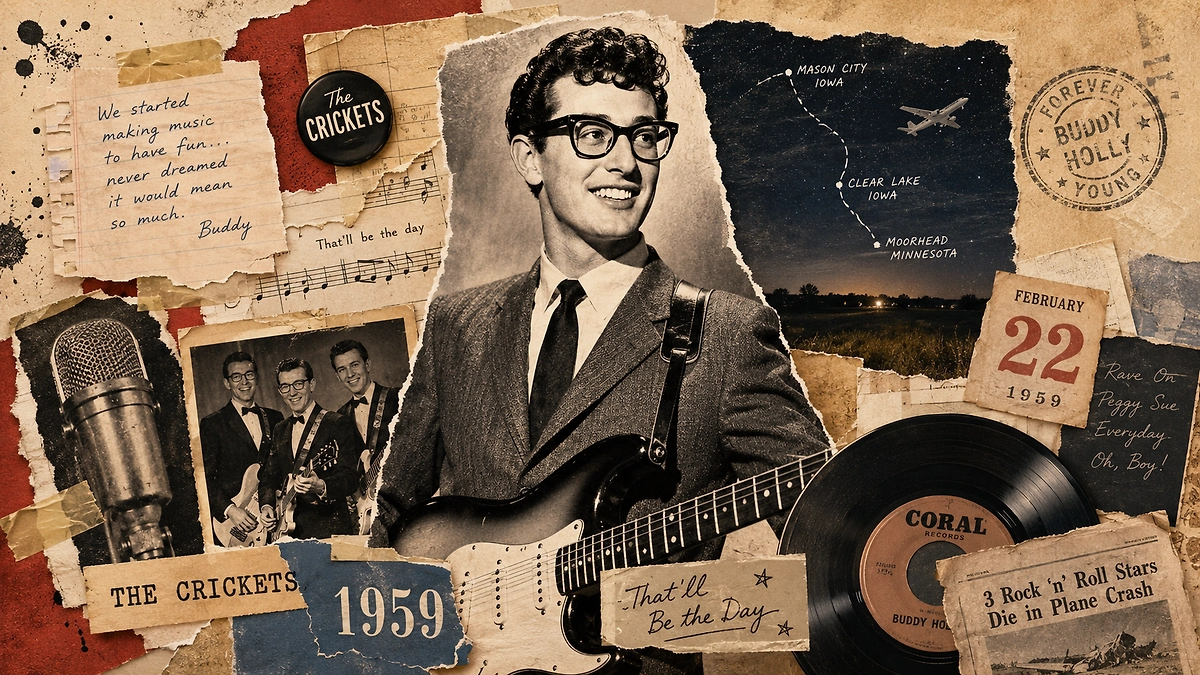
Buddy Holly, one of the most influential figures in rock and roll, would have celebrated his 90th birthday on September 7, 2026. Despite his brief life, which ended at the young age of 22, Holly made a lasting impact on the music world, leaving behind iconic hits like "That’ll Be the Day," "Peggy Sue," "Everyday," and "Not Fade Away." His innovative approach and songwriting abilities not only shaped the sound of his era but also inspired future legends, including The Beatles and The Rolling Stones.
Born Charles Hardin Holly on September 7, 1936, in Lubbock, Texas, Holly's early musical endeavors began in childhood, experimenting with the piano and guitar. Initially rooted in country music, his career took a pivotal turn after witnessing Elvis Presley perform in Texas, sparking his transition to a rock and roll sound that blended country and rhythm and blues.
Holly's first attempt at a music career with Decca Records fell flat, but everything changed in 1957 when he formed The Crickets with Jerry Allison, Joe Mauldin, and Niki Sullivan. Their recording of "That’ll Be the Day" on February 25, 1957, marked a significant breakthrough, paving the way for a series of hits that defined early rock and roll, including "Peggy Sue," "Everyday," and "Rave On."
What makes Holly's contributions vital to rock music is not just his catchy melodies but the foundational band structure he established: a lead vocalist-guitarist, supporting guitar, bass, and drums. This model became the template for future rock groups, allowing musicians to take on roles beyond mere accompaniment. His influence resonated with young artists, particularly those who would later form The Beatles.
The connection between Holly and The Beatles runs deep. The Quarrymen, the precursor to The Beatles, covered "That’ll Be the Day," one of their earliest recordings. The Beatles not only admired Holly's music but also drew inspiration from The Crickets when naming their own band, even incorporating a playful twist on the name to become "The Beatles."
Holly's influence also reached The Rolling Stones, who recorded a version of "Not Fade Away," which helped them gain traction in the UK music scene. This interconnected legacy illustrates how an American teenager from Texas created a minimalist rock and roll sound that would resonate globally, influencing British musicians who transformed it into a worldwide phenomenon.
The unmistakable image of Buddy Holly, characterized by his thick black glasses, set him apart in an era when rock stars often embodied a more glamorous persona. He redefined what it meant to be a rock star, showing that a skinny Texan in a suit and glasses could captivate audiences.
Tragically, Holly's life came to an abrupt end on February 3, 1959, in a plane crash while traveling for a winter tour. He was aboard a Beechcraft Bonanza with fellow musicians Ritchie Valens, J.P. "The Big Bopper" Richardson, and pilot Roger Peterson when the plane went down shortly after takeoff. This day would later be referred to as "the day the music died," marking a profound loss for the music community.
Holly's brief but impactful career continues to resonate today, influencing countless musicians and shaping the rock genre's future. His legacy serves as a reminder of the potential for artistic innovation, even in a short span of time. As new artists emerge, Holly's contributions remain a benchmark, inspiring competition and creativity in the ever-evolving music landscape.
Informational material. 18+.