
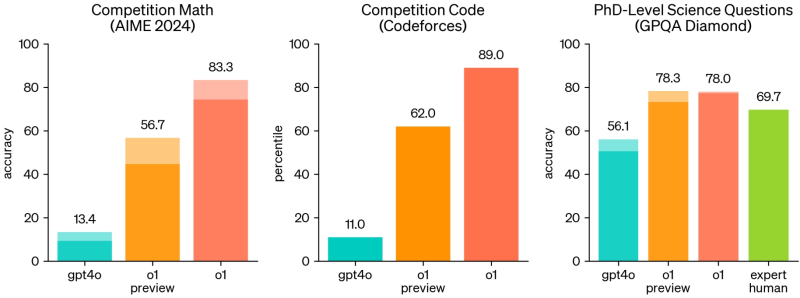
OpenAI's latest language model, dubbed o1, has made headlines by achieving remarkable success in complex reasoning tasks. This model, unveiled in autumn 2024, has demonstrated an impressive capability to tackle the American Invitational Mathematics Examination (AIME), scoring 74% on its first attempt. After employing a consensus method to refine its answers, o1's performance improved significantly to 83%, and with additional enhancements, it reached a staggering 93%. These results have positioned o1 as a prominent player in the field of large reasoning models (LRM).
In a rigorous test known as GPQA Diamond, which assesses scientific reasoning rather than mere fact retrieval, o1 achieved a score of 78%, outperforming the average score of wet lab experts who hover just below 70%. This demonstrates the model's advanced cognitive abilities, particularly in areas like biology, physics, and chemistry. O1 stands out among its peers, which include successors and competing models such as o3, Claude Fable 5, and Google Gemini 3.1 Pro.
The operational design of reasoning models like o1 mimics what psychologist Daniel Kahneman describes as "system 2" thinking—characterized by deliberate and analytical thought processes. In contrast, traditional autoregressive models tend to operate on "system 1" principles, enabling quick, instinctual responses but lacking in-depth analytical capabilities. This distinction highlights why o1 excels in logical reasoning tasks, a departure from the more limited performance of earlier models.
OpenAI's commitment to developing artificial general intelligence (AGI) remains steadfast, but the emergence of reasoning models raises questions about their role in the broader AI landscape. With their ability to engage in more complex thought processes, LRMs may redefine expectations in AI capabilities, influencing market dynamics and setting new standards for competitors in the industry. As these technologies evolve, they could reshape how AI is integrated into various sectors, from education to research and beyond.
Informational material. 18+.