
OpenAI has reported the identification and blocking of two information campaigns it claims are linked to China, which utilized ChatGPT to generate content aimed at swaying public discussions on artificial intelligence, data centers, trade tariffs, and U.S. technology policy.
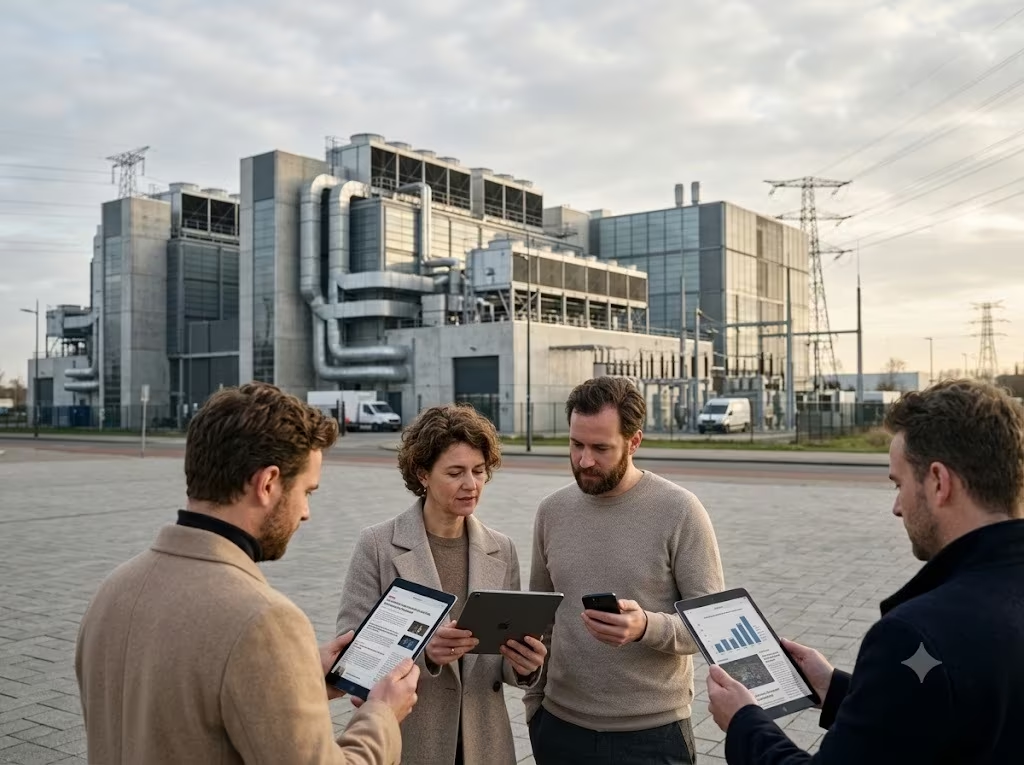
One of the most notable operations was dubbed the Data Center Bandwagon. This campaign allegedly involved using ChatGPT to create social media posts and visuals asserting that the rapid construction of AI data centers is driving up electricity prices for Americans. While OpenAI acknowledges that energy consumption by data centers is a subject of active public debate, it believes that foreign actors attempted to exploit existing American concerns to promote their own interests.
The second campaign, named Tech and Tariffs, focused on criticizing U.S. trade tariffs, portraying them as a pressure tool in global technology competition. OpenAI's analysis indicated that some queries directed at the model explicitly suggested emphasizing former President Donald Trump while avoiding mentions of Chinese President Xi Jinping.
Additionally, OpenAI linked these activities to a network of suspected fake social media accounts that were disseminating false claims regarding a supposed data leak from ChatGPT.
Despite these serious allegations, OpenAI found no evidence that either operation had a significant impact on public opinion. Their assessment suggested that the spread of content was largely confined to the activities of the campaign organizers themselves.
The emergence of such campaigns is noteworthy, indicating a shift in the U.S.-China rivalry in AI from traditional areas like chip manufacturing and computational power to now include public discourse surrounding AI infrastructure. Modern data centers have become a strategic asset for AI development, requiring vast amounts of electricity and multi-billion dollar investments, effectively determining the computational resources available for training and deploying advanced models.
Any slowdown in the construction of new data centers or increased political resistance to such projects could potentially influence the pace of growth in the American AI industry. Similarly, public sentiment regarding tariffs and technological restrictions could impact policies aimed at limiting China's access to advanced technologies.
OpenAI emphasized that criticism of data center energy consumption, their environmental impact, or economic efficiency is not misinformation in itself. The company believes that the identified networks did not introduce new contentious points but rather sought to exploit existing divisions within American society.
By publishing the findings of its investigation, OpenAI aims to assist government agencies, businesses, and researchers in detecting attempts to manipulate public opinion through AI-generated content. As global competition in AI intensifies, the battle between technological powers is increasingly extending beyond laboratories and chip manufacturing plants. Influencing public opinion may prove to be a significantly cheaper strategy than building new computational capacities, yet it can yield equally important strategic outcomes.
Informational material. 18+.