

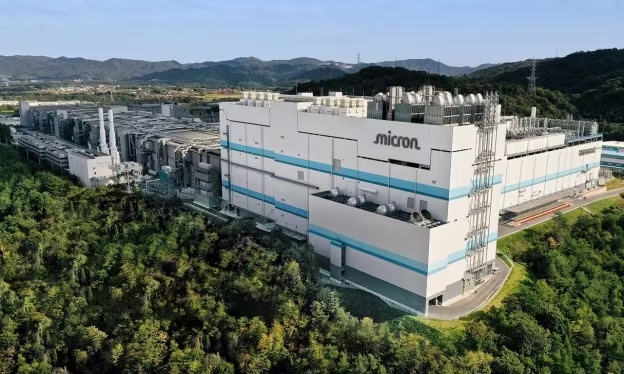
American semiconductor giant Micron Technology has announced a significant expansion of its high-bandwidth memory (HBM) production in Japan, committing approximately $9.2 billion to enhance its facility in Hiroshima. This strategic move comes as demand for infrastructure to support artificial intelligence (AI) systems surges.
The expansion aims to bolster the production of next-generation HBM, which is crucial for the efficiency of modern AI systems and graphics accelerators. HBM is highly valued in AI accelerators and high-performance GPUs due to its ability to transmit large volumes of data with minimal latency and high energy efficiency. This type of memory has emerged as both a critical bottleneck and a growth driver within the AI industry, directly impacting the performance of computing clusters.
Scheduled to begin operations in the second half of 2028, the Hiroshima facility will see its expansion partially funded by the Japanese government, which is considering a subsidy of approximately $3.1 billion. This initiative aligns with Japan's strategy to strengthen its national semiconductor base by attracting global manufacturers.
Micron's Hiroshima site is already a key player in the company's DRAM production. The facility has undergone modernization through the adoption of extreme ultraviolet (EUV) lithography, which enables the creation of smaller and denser transistor structures, advancing from a 1-beta to a more advanced 1-gamma technology node. The new expansion builds upon this existing technological framework, enhancing the site's strategic importance within Micron's global production network.
In parallel with this expansion, Micron is employing a distributed manufacturing model to rapidly scale up its capacities in response to the swift increase in demand. This approach minimizes reliance on a single production site and allows for greater flexibility in reacting to cyclical fluctuations in the memory market.
The HBM market remains one of the most competitive segments in the semiconductor industry, with SK Hynix currently holding a leading position by supplying a significant portion of memory for Nvidia's AI accelerators. Samsung Electronics is also ramping up its production, intensifying competition.
Micron is steadily increasing its market share as it expands HBM supplies with new generations of products. This investment signifies a proactive approach in a rapidly evolving industry, likely enhancing Micron's competitiveness and influence in the high-performance memory sector.
Informational material. 18+.