
The neural network market in Russia is growing, but the data regarding their popularity has been fragmented. To gain a clearer understanding, we decided to combine these statistics with our internal analytics and data related to search neural blocks.
The goal was to determine the market share held by various neural networks in Russia, including generative AI, Yandex’s neural responses, and those integrated into Google’s search results.
Yandex Neural Responses
This information is crucial for our work in GEO-promotion, especially in neural responses, as we need to focus on the most widely used AI systems.
Methodology
We gathered data from surveys by VCIOM, Mediascope, and Microsoft AI Economy from October-November 2025. A major challenge was that these sources didn’t include neural AI integrated into search engines, and they often collected different data under similar goals. To address this, we combined search data and isolated the percentage of results with neural responses, giving us a rough estimate of the total audience size.
The total audience share may exceed 100%, as many users interact with multiple neural networks.
Important Note: Some data is missing from one or more sources, so numbers may not always match. For example, the audience size in different reports may vary.
What percentage of Russians use neural networks?
According to VCIOM, 51% of Russians have tried neural networks in the past year. Built-in neural responses (24-30%) appear when users search. Mediascope reports 26% use AI actively in specific services, while Microsoft notes that 8% use AI exclusively for work. In total, 42-56% of the population interacts with AI in some form.
Who is this audience?
The core group of active AI users is young people aged 12 to 34 years, according to Mediascope’s data on monthly AI reach.
Neural Network Market Share in Russia for 2025-2026
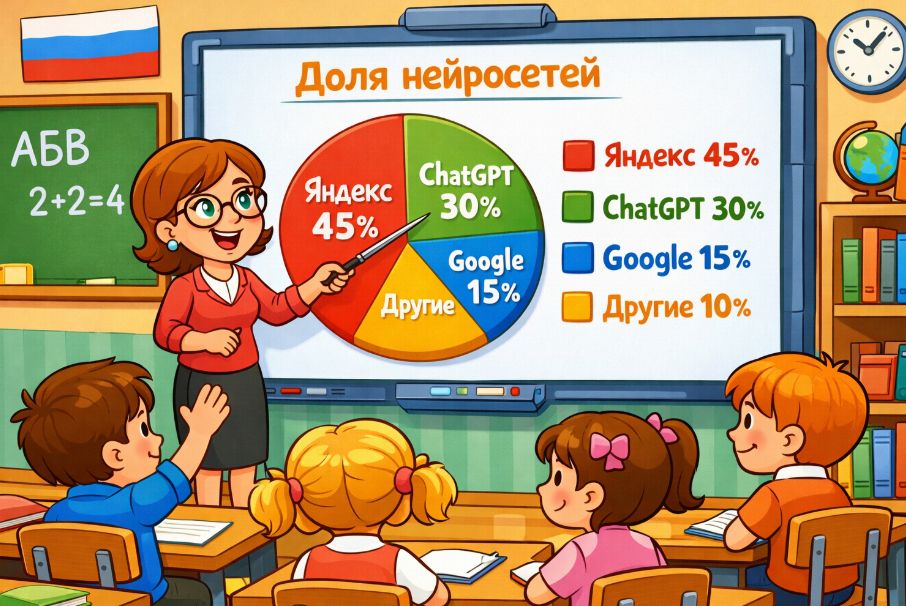
As expected, Yandex leads with a share of 34-61%. This includes data from the separate chat service Alice, its app, and its neural block integrated into the search engine.
DeepSeek surprisingly follows with a share of 13-18%, likely due to its free access and availability without VPNs.
Google comes in third with a 5-10% share, mostly from its integrated search neural responses. The Gemini network has a negligible presence in Russia.
ChatGPT holds a 5-6% share, while Perplexity trails with 2-3%. Despite being a global leader, ChatGPT’s share in Russia is smaller than expected. Perplexity, on the other hand, is often praised as an excellent search engine, but its share remains limited in Russia.
Traffic from Neural Networks to Company Websites
We also explored the commercial side of neural networks, specifically the number of website visits driven by neural responses.
Important Note: Traffic from Yandex and Google’s neural responses is not visible in web metrics like Yandex.Metrica, as these search engines do not share such data. However, we conducted an independent analysis of metrics for client websites, and the results were consistent.
Project: Large B2C eCommerce
Project: Transportation Company for Business
Project: Specialized B2C eCommerce
Alice saw an overwhelming victory, particularly toward the end of the year when we actively promoted neural network responses. However, our efforts influenced visibility across all neural networks, and Alice’s traffic growth was notable. Here’s an example from one of the projects:
Visibility in All AI Networks and Results
Google took a clear lead, while Alice, ChatGPT, and Perplexity all ranked similarly. Notably, traffic from ChatGPT to websites grew less rapidly than traffic from Alice. The 5-6% market share estimate for ChatGPT appears to be accurate, as confirmed by the data.
We also consulted PixelTools’ dashboard, which measures traffic across a large sample of 3,000 websites. The results from this tool mirrored the trends from other sources:
PixelTools Dashboard Results
Alice leads with 67.5% market share, followed by Perplexity at 15.3% and ChatGPT at 14.4%. DeepSeek’s presence was almost nonexistent in this sample. It only accounted for a small portion of the traffic on 20% of the sites in the sample, and even then, its share was very low.
This may be attributed to DeepSeek’s outdated search interface, which pulls information from an older database when the search button isn’t pressed, providing outdated results instead of the latest information from the internet.
Which Neural Networks to Focus On for Promotion?
If your goal is to drive website traffic from neural networks, prioritize:
Yandex with Alice
Google (integrated neural block in classic search)
ChatGPT
Perplexity
DeepSeek
If brand contact is your main KPI, refer to the table below:
Table for Working with Brands and Their Promotion in AI
We’ve added two additional metrics:
Result stability, which shows how consistent the presence of specific brands is in the search results and answers. Stability is important as it indicates whether a brand’s presence remains steady over time.
Result speed, which reflects how quickly neural networks update their responses with new content. For example, ChatGPT and DeepSeek may take longer to provide information about a brand, even if trusted sources exist. Yandex, however, often responds within a day.
GEO-promotion remains a compelling channel for influencing multiple metrics simultaneously, including:
Website and brand visibility in AI responses
Traffic from neural networks
Traffic from publications
Brand interactions
Reach and publication views
Share of Voice (SOV) against competitors
Requests from AI
Brand traffic to websites
SEO rankings and the number of top-10 listings
This trend highlights the growing importance of leveraging neural networks in digital marketing, particularly in sectors where AI-powered search and content recommendations play an increasingly significant role.
Informational material. 18+.