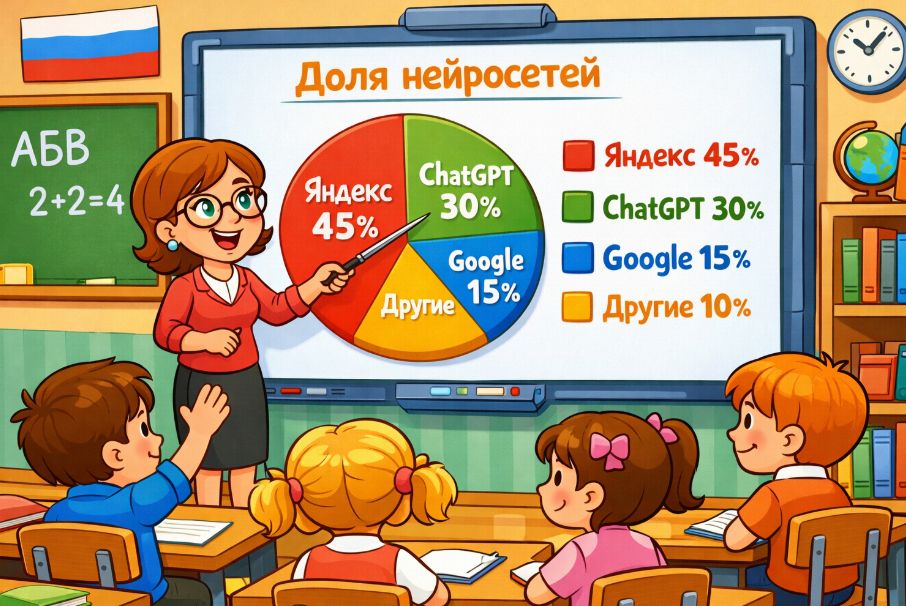


Recent findings reveal that the search results from AI assistants Claude and ChatGPT overlap by only about 20%, meaning a significant 80% of their sources, data, and conclusions differ. This disparity highlights the varying capabilities and methods of different AI search engines. For instance, both Claude and ChatGPT recently provided information about a nonexistent law, illustrating the potential pitfalls of relying solely on one AI system for research.
As of April 2026, the landscape of AI is rapidly evolving, making it essential to stay updated with the latest functionalities and pricing on each platform. Over the past year, I have extensively utilized neural networks for research purposes, including information gathering, fact-checking, and comparisons. Through this experience, I developed a systematic approach that has proven to be efficient, saving me several hours each week while yielding far more comprehensive results than single-neural network searches.
Claude, ChatGPT, and Gemini each utilize different search engines to deliver their results. Claude relies on Brave Search, which indexes around 30 to 40 billion pages, while ChatGPT uses Bing in conjunction with OpenAI's ranking layer, covering approximately 8 to 14 billion pages. Gemini, on the other hand, integrates Google Search, which boasts a staggering index of about 400 billion documents. Additionally, Perplexity operates on its own index, claiming to cover hundreds of billions of sources.
The importance of these distinctions cannot be overstated. An analysis by Semrush revealed that only 14% of the sources cited across different AI platforms overlap among ChatGPT, Perplexity, and Google AI. Furthermore, SearchAtlas reports that the alignment of ChatGPT's results with Google Search is a mere 10-15%. This means that querying three different AIs on the same topic will yield three unique sets of sources, a feature that can be strategically utilized.
Understanding the difference between Web Search and Deep Research within neural networks is crucial. Web Search is a quick method where the AI makes several queries to a search engine, reviews initial results, and compiles them into an answer. This process takes mere seconds and is suitable for straightforward factual inquiries. In contrast, Deep Research is a thorough investigation where the AI creates a plan, analyzes dozens or even hundreds of sources, reads articles in-depth, and assembles a structured report. This method typically takes between 2 to 15 minutes.
For initiating Deep Research, all three services follow a similar process, initiated by clicking a specific option under the input field. Claude often asks clarifying questions if the initial request is vague, while ChatGPT usually takes slightly longer to search. Gemini displays a research plan that can be adjusted before starting.
The reports generated by these AIs include specific sources and links to the articles used, setting them apart from standard chat responses, which may lack citation accuracy. Neural networks excel at interpreting natural language requests, so a few descriptive sentences are usually enough. However, for more complex topics, users can ask the AI for assistance in crafting a well-defined Deep Research prompt.
Over the past year, I have categorized my inquiries into three levels based on their significance. For everyday questions, I typically turn to Claude, as it serves as my primary AI with a subscription offering generous limits. For more complex queries requiring a broader perspective, I incorporate Gemini, capitalizing on its access to Google's vast index. However, I find Gemini's reporting style to be verbose and convoluted, so I use Claude to edit and summarize the findings for readability.
For high-stakes inquiries, such as medical research or financial decisions, I adopt what I term "Ultra Deep Research," utilizing Claude, Gemini, and ChatGPT in conjunction. This method triangulates the information across three independent search engines, allowing for a comprehensive view of the topic and making discrepancies easily identifiable.
In terms of pricing for Deep Research, Claude Max 5x costs $100 per month, providing extensive features, while Gemini AI Plus is available for $8 per month for Pro users. As AI continues to advance, the strategies and tools employed for research will increasingly influence market dynamics and competitive positioning within the industry.
Informational material. 18+.