
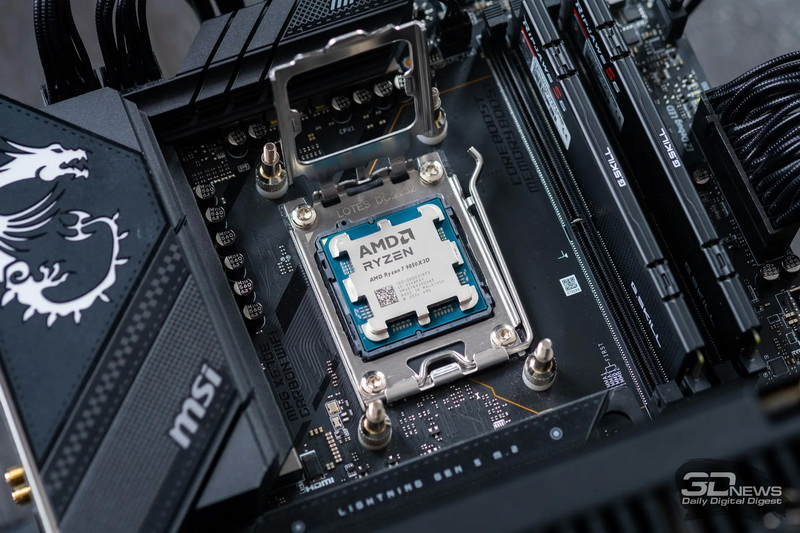
At the Morgan Stanley Technology, Media & Telecom Conference 2026, both AMD and Intel reported an unexpected spike in demand for central processing units (CPUs) driven by the rapid advancement of artificial intelligence (AI) technologies. Intel's Chief Financial Officer, David Zinsner, remarked that "CPUs are back in demand this year," attributing this increase to the growing need for processors to manage resource-intensive computations performed by graphics processing units (GPUs) and neural processing units (NPUs). In response to this rising demand, Intel has begun signing long-term agreements with clients to ensure a steady supply of chips necessary for scaling their operations.
Meanwhile, AMD's CEO, Lisa Su, echoed these sentiments, noting a significant increase in demand for processors related to an upsurge in inference tasks. She admitted that the level of demand has exceeded her initial expectations.
The AI boom, which began with the launch of the ChatGPT chatbot in 2022, has led to shortages of various computer components, initially impacting the GPU market. Data centers and major cloud companies rushed to acquire GPUs to build powerful servers equipped with thousands of these units. As GPU supplies started to normalize around mid-2025, analysts began warning of looming shortages in RAM and memory chips due to the surging demand for high-speed memory and corporate storage solutions aimed at AI operators.
The market felt the full impact of this crisis in the fourth quarter of last year when prices for RAM modules and SSDs skyrocketed to record highs. This trend is anticipated to continue, with analysts predicting that contract prices for DRAM could double in the current quarter, while NAND prices may rise by at least 50%. The memory market's crisis is reportedly more impactful than the GPU shortage, as memory chips are utilized in nearly every modern digital device, from consumer products like smart TVs and smartphones to vehicles and industrial equipment.
As AI continues to evolve—from large language models and chatbots to agent systems capable of observing, reasoning, planning, acting, and learning independently—data centers are increasingly demanding the computational power of multiprocessor systems, combining CPUs, GPUs, and NPUs. This trend is already reflected in a surge of interest for Intel and AMD processors in China, where some companies report shortages of server processors. The rise of popular agent AIs such as Clawdbot, Moltbot, and OpenClaw for local use has also led to increased demand for high-performance systems like Apple's Mac Studio and Mac mini.
While both AMD and Intel are experiencing heightened demand for their processors, this primarily pertains to server-grade chips, which are predominantly driven by data center requirements. Consumer systems, in general, are not yet prepared for large-scale local deployments of agent AI, which would necessitate significant amounts of available memory.
For several generations, AMD and Intel have moved towards unification, allowing them to maximize profits through a shared microarchitecture for both consumer and corporate solutions. Unlike Nvidia, which has seen exponential revenue growth due to increasing demand for high-performance memory and GPUs from the data center segment, AMD and Intel still derive about half of their quarterly revenue from the consumer market, which remains critical for them.
While the demand for high-performance server processors may rise, it is unlikely to occur at the expense of the consumer market, at least not to the same extent as seen in the memory sector.
Both companies must strive to meet the demand for processors to avoid exacerbating the already challenging situation in the overall PC market. Failure to do so may lead to predictions of the end of the entry-level PC era by 2028 if current trends continue. The implications of this surge in demand could reshape the competitive landscape, forcing rivals to adapt quickly to stay relevant.
Informational material. 18+.