

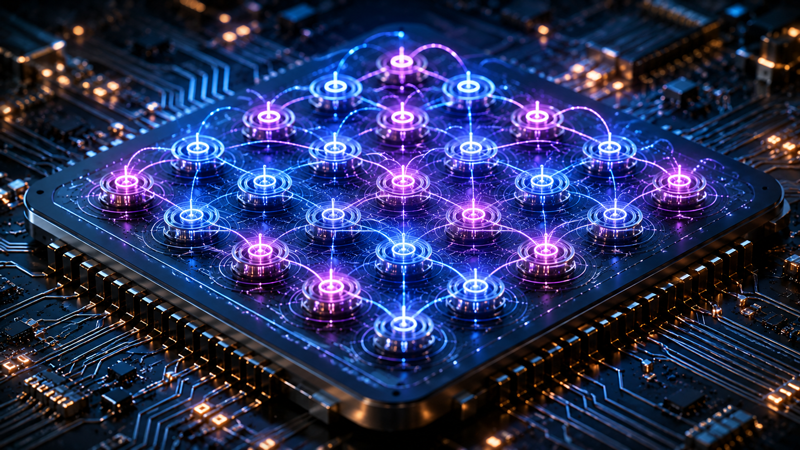
Researchers at the Korea Advanced Institute of Science and Technology (KAIST) have unveiled a groundbreaking computing system that employs silicon oscillators, capable of solving complex combinatorial problems at speeds vastly exceeding those of traditional semiconductor computers. This innovation could lead to processors operating millions to billions of times faster than their classical counterparts.
One classic example of a combinatorial challenge is the traveling salesman problem, which involves determining the most efficient route that visits multiple locations. Traditional computers tackle this issue through brute force or specialized algorithms, often requiring substantial time to find a solution.
While quantum systems, including those utilizing quantum annealing, promise significant advances in solving combinatorial tasks, practical applications of such technology remain limited. The new discovery from South Korean scientists could bridge this gap, enabling the resolution of combinatorial problems as well as tasks in statistical physics, finance, chemistry, and materials science using conventional silicon transistors imbued with new capabilities.
The researchers framed their work within a philosophical perspective, identifying three distinct eras of transistors. The first era involved transistors functioning as switches, while the second revolved around their role as amplifiers. The latest development marks the onset of the third era, where transistors act as oscillators, forming computational platforms based on the Ising model, which facilitates statistical calculations across various fields.
The Ising model, initially designed to describe material magnetization, manipulates atomic spins within a crystalline lattice, seeking the lowest energy configuration. The final state of this system provides the computational result when implemented in an Ising machine, which can solve specific problems in mere hours compared to the thousands of years required by classical systems.
At the heart of this innovation is the oscillatory Ising machine, a specialized computational device where numerous oscillators exchange signals and synchronize their frequencies, naturally converging towards the most stable state of the system—akin to reaching the optimal solution. The researchers successfully developed the oscillators and their interconnections using standard silicon transistors, enhancing synchronization accuracy and improving the processing of complex computational models.
Initial experiments demonstrated the system's high efficiency in tackling the maximum cut problem, widely applicable in logistics, financial analysis, and semiconductor design. A significant advantage of this technology is its compatibility with existing CMOS manufacturing processes, paving the way for mass production without the need for new factories or specialized materials.
As the miniaturization of transistors approaches physical limits, this new concept holds the potential to establish fundamentally new computing architectures, poised to transform the future of the semiconductor industry. The dawn of the third era of transistors appears imminent, with strong grounds for optimism among researchers. This advancement could not only reshape the technology landscape but also intensify competition among industry players as they adapt to these emerging capabilities.
Informational material. 18+.