

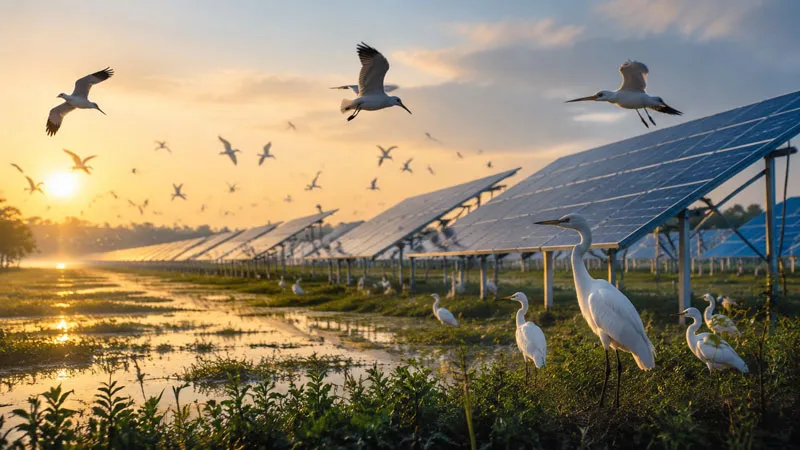
A recent study has raised concerns about the ecological impact of solar energy expansion in China, revealing a significant decline in bird diversity potentially linked to the development of solar farms. Researchers from China, Vietnam, and the United States analyzed data from over 2,300 administrative regions across China from 2014 to 2023. They found a statistically significant negative correlation between government support for solar energy and the number of bird species in these areas. Specifically, the study indicated that for every unit increase in support for solar energy, there was an approximate 2.1% decrease in the bird diversity index. This suggests that increased financial and land allocation for solar power plants has detrimental effects on local bird populations.
The researchers utilized data on solar farm sizes alongside a specific index that measures the strength of government policies promoting photovoltaic energy. This method allowed them to evaluate the effects of policies encouraging solar infrastructure development rather than just the installed capacity. To assess bird community health, they employed the Shannon diversity index, which considers both the number of species and their population distribution. Data on bird populations were sourced from the China Birdwatching Record Centre and compared with solar policy maps and land use data.
The primary factor contributing to biodiversity loss was identified as habitat alteration. Large solar farms necessitate land transformation, which can result in the destruction of feeding and nesting grounds, as well as the fragmentation of remaining natural habitats. The most pronounced effects were observed in economically developed areas and regions with complex ecosystems, where replacing natural landscapes with solar infrastructure had a more significant impact. Conversely, in arid desert regions with low biological activity, no statistically significant harm to bird populations was found.
While the researchers noted that solar energy itself is not inherently harmful to nature—solar panels can create shaded areas, promote vegetation growth, and provide new habitats for various insects and animals—the ecological impact largely depends on the placement of these facilities. The authors advocate for considering the biological value of areas when planning new solar projects, especially along migratory bird routes. They argue that the transition to renewable energy should be accompanied by stricter conservation measures to prevent hidden losses in biodiversity.
The findings highlight a critical ecological dilemma, emphasizing the need for careful territorial planning to avoid unintended consequences for local wildlife. As solar energy continues to expand, it is essential for policymakers to integrate biodiversity conservation into their strategies, particularly in regions with rich ecological diversity. This scrutiny could reshape the market dynamics for solar energy developers and compel competitors to adopt more sustainable practices in their projects.
Informational material. 18+.