
A novel framework known as Spec-Driven Documentation (SDD) has been introduced to enhance the development of technical documentation within software repositories. As software systems grow increasingly complex, documentation is evolving from mere supplementary text to a vital engineering asset that plays a crucial role in decision-making, requirement alignment, architecture design, testing, and operations. However, the current landscape often sees documentation created in a fragmented manner by multiple authors using inconsistent formats, leading to a loss of coherence and increased communication costs.
In software projects, technical documentation encompasses a variety of artifacts, including requirements, use cases, diagrams, and architectural descriptions, which are often distributed among team members and stages of the development lifecycle. This dispersion can create inconsistencies, with some documents evolving rapidly while others remain at early hypothesis stages. Such discrepancies result in a lack of traceability and complicate the process of establishing causal relationships between different artifacts, ultimately increasing review costs and the risk of erroneous engineering conclusions.
The rise of AI-assisted tools for generating documentation further complicates the situation. While these tools can produce content quickly, they have limitations in terms of the amount of information they can handle at once. Consequently, the quality of consistency and retention of previously established definitions may decline as the volume of documents and interrelations grows. This scenario increases the likelihood of critical conditions being overlooked and inconsistencies arising across documents, rendering the documentation process both costly and poorly managed.
The objective of the SDD framework is to formalize a methodology and create an environment for the reproducible development of technical documentation through controlled AI participation. Under this approach, documentation is viewed as a proactive project artifact, essential for researching and formalizing subject areas, capturing assumptions and constraints, and clarifying data and architectural decisions. By establishing a coherent and traceable documentation framework, the aim is to reduce uncertainty and the costs associated with changes during the coding phase.
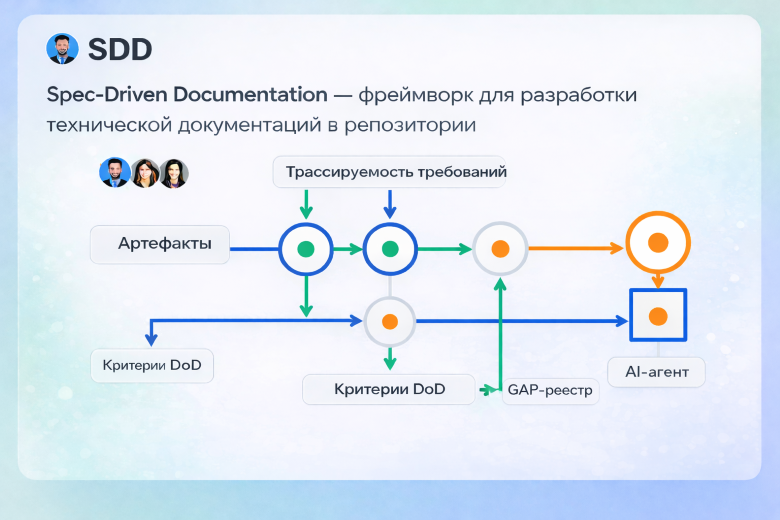
The innovative aspect of SDD lies in its process-artifact approach to technical documentation, defining documentation as a linked contour of specifications with established classes of artifacts, traceability types, and evolution rules during the R&D phase involving AI agents. The framework introduces readiness criteria and a mechanism for managing uncertainty via a GAP register, which differentiates confirmed knowledge from assumptions and open questions.
Practically, the SDD framework provides elements that can be integrated into projects using a docs-as-code approach, without requiring changes to the existing development technology stack. These include a model for artifacts, basic invariants for traceability, a Definition of Done for key artifacts, a GAP register for R&D, and protocols for human-AI interaction that clarify responsibilities and conditions for human intervention.
The effectiveness of this approach, including its impact on maintenance labor, the incidence of conflicts, traceability completeness, and review quality, will require empirical validation and is considered a direction for future work. This framework is particularly beneficial for software projects where technical documentation is treated as a managed engineering artifact. It emphasizes the importance of versioned storage, review processes similar to code changes, and the ability to trace relationships between requirements, use cases, models, and architectural decisions.
While SDD enhances the manageability of documentation processes, it does not replace the need for subject matter and architectural expertise. The responsibility for critical assumptions and conclusions remains with developers and architects, ensuring that despite the use of AI, human oversight is crucial for maintaining domain accuracy.
The introduction of SDD could significantly streamline documentation processes in the software industry, enhancing the efficiency and accuracy of technical documentation while also setting a new standard for competitors in the field.
Informational material. 18+.