

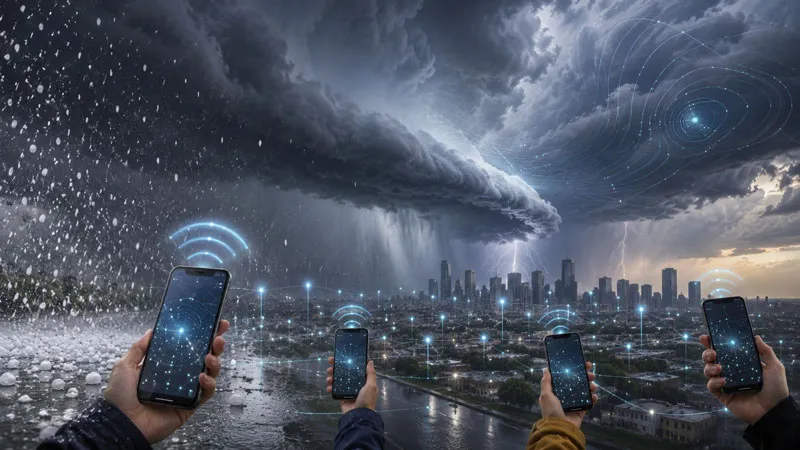
Chinese meteorologists have demonstrated that millions of ordinary smartphones can be transformed into a dense network of sensors capable of predicting thunderstorms and hail. These weather phenomena pose significant risks to human safety and agriculture, as accurate forecasts remain elusive. The proliferation of smartphones equipped with barometers opens new avenues for precise storm predictions.
Researchers from Peking University utilized data from smartphone barometers to forecast hail in Beijing on June 30, 2021. User data was anonymously collected through the Moji Weather app and adjusted using machine learning algorithms. The atmospheric pressure readings were integrated into the Weather Research and Forecasting (WRF) numerical model. Several simulations were conducted for comparison: one without smartphone data, another with data from traditional weather stations, and two utilizing smartphone data with different error correction methods. The primary concept behind this approach is that surface pressure effectively reflects the small-scale storm front structures, including cold air volumes and front dynamics. However, conventional weather stations are often too sparsely located to monitor these details accurately.
The results were promising, showing a 14-17% improvement in the accuracy of hail prediction when using smartphone data compared to the control simulation. Furthermore, smartphones enhanced the depiction of storm air mass contours and dynamics. In this instance, predictions based on smartphone data were superior to those relying solely on traditional weather stations, highlighting the potential of this innovative method for gathering meteorological information.
However, it is important to note that smartphones cannot yet replace traditional weather stations. A significant limitation of this approach is the uneven distribution of data; while smartphones are prevalent in urban areas, they are scarce in mountainous regions and rural areas. The storm studied by researchers formed over mountainous terrain, indicating that the smartphone network could not fully rectify modeling errors during the storm's early development, although it did improve predictions once the storm impacted the capital.
As this technology continues to develop, further research is needed to refine its accuracy and effectiveness. This advancement could reshape weather forecasting, providing a competitive edge in the meteorological field and influencing how weather data is collected and utilized in the future.
Informational material. 18+.