
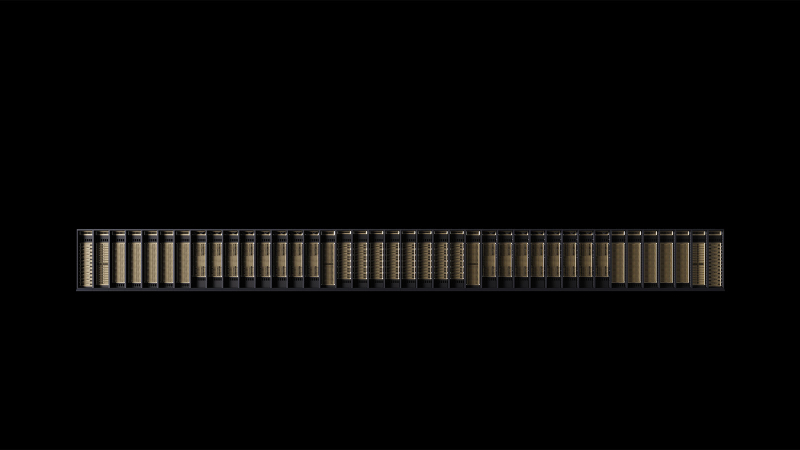
NVIDIA has announced the launch of its Vera Rubin platform, which now integrates a total of seven advanced chips, signaling a new era in agent AI. The latest addition, Groq's LPU 3, follows NVIDIA's record-breaking $20 billion acquisition of Groq just three months prior. This comprehensive platform combines Arm processors, Rubin accelerators, NVLink 6 interconnects, ConnectX-9 SuperNIC adapters, BlueField-4 DPUs, and Spectrum/Quantum-6 Ethernet switches to process AI workloads effectively at every stage.
Jensen Huang, NVIDIA's founder and CEO, described Vera Rubin as a major leap forward, featuring seven groundbreaking chips and five racks that together form a colossal supercomputer designed for all aspects of AI operations. The new system promises to boost the development of agent AI, marking what Huang termed a historic shift in infrastructure deployment.
Key industry leaders have praised the platform. Dario Amodei, CEO of Anthropic, emphasized that it provides critical computing resources, networking capabilities, and system architecture that enhance security and reliability. Meanwhile, Sam Altman, CEO of OpenAI, highlighted that with Vera Rubin, they aim to deploy more powerful models at scale, delivering faster and more reliable systems to millions.
NVIDIA claims that Vera Rubin offers the most extensive AI platform available. Specifically, the NVL72 supercomputer can train large Mixture of Experts (MoE) models with significantly fewer accelerators than previous platforms, achieving up to ten times the inference throughput per watt at a lower cost. The Vera CPU rack pairs 256 Vera processors in a high-density configuration to deliver scalable, energy-efficient performance for agent AI applications.
The integration of Groq's LPX racks further enhances the system's capability, offering up to 35 times the inference throughput per megawatt and opening new revenue potentials for trillion-parameter models. These LPX racks work in unison with the Vera platform to efficiently manage extensive AI model demands.
To support these advancements, NVIDIA launched the BlueField-4 STX storage solution, optimized for AI workloads, which enables seamless GPU memory expansion. This innovation allows for high-speed data layers designed specifically for the large volumes of key-value caches generated by AI models.
Additionally, NVIDIA introduced the DSX platform featuring Dynamic Supply eXchange Max-Q technology. This allows for a 30% increase in AI infrastructure within data centers without raising energy consumption. The DSX Flex software grants AI facilities the flexibility to tap into underutilized grid power.
Products based on the Vera Rubin platform will start rolling out with NVIDIA partners, including major hyperscalers like AWS, Google Cloud, and Microsoft Azure later this year. Global hardware manufacturers are also expected to support this innovative platform.
The introduction of the Vera Rubin platform signifies a substantial advancement in AI technology, promising enhanced efficiency and capacity that could reshape market dynamics and give NVIDIA a competitive edge over rivals. As businesses increasingly rely on AI capabilities, this launch positions NVIDIA at the forefront of the industry, potentially impacting competitors' strategies and offerings.
Informational material. 18+.