
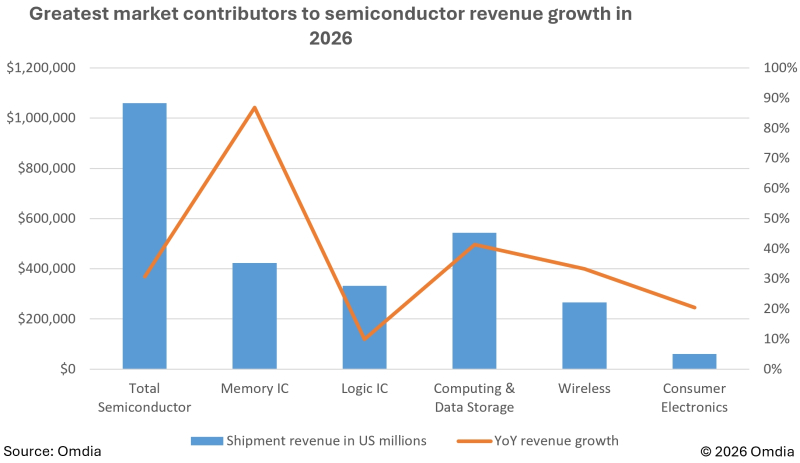
The global semiconductor industry is poised to achieve unprecedented revenue, expected to exceed $1 trillion for the first time in history in 2026. This remarkable milestone, projected by analysts at Omdia, represents a 30.7% increase from the previous year, driven largely by the escalating demand for chips used in artificial intelligence infrastructure. Although the growth is not solely dependent on AI-related orders, they play a significant role in this financial surge.
The report indicates that the revenue from memory chips, particularly DRAM and HBM for AI servers, is set to increase by nearly 90% year-over-year. In contrast, NAND chips will see only a 40% rise, while general computing logic chips, including CPUs and GPUs, will experience a modest 10% growth. This trend suggests that the prices of memory chips will continue to rise, fueled by the insatiable appetite of hyperscalers—large tech companies investing heavily in expanding their data centers and enhancing server capabilities for generative tasks.
Leading hyperscalers such as Amazon Web Services, Microsoft Azure, Google Cloud Platform, and Meta are projected to invest approximately $500 billion in capital expenditures throughout 2026. This aggressive expansion reflects the sustained demand for various AI services, which is forecasted to grow from $439.44 billion in 2025 to $588.65 billion in 2026, and further to $761.04 billion by 2027.
However, this growth in monetary terms does not translate into a proportional increase in the number of chips supplied. Chip manufacturers are hesitant to expand production capacity amidst rising customer demands, opting instead to prioritize the production of chips that cater to AI applications. This strategy has led to soaring profit margins for semiconductor companies, as they reduce output of traditional chips, resulting in shortages and higher prices for servers, PCs, and smartphones.
Recent reports indicate that AMD and Intel are preparing to raise prices on server processors by about 15%, while Samsung and SK Hynix may increase NAND chip prices by over 100%. This trend of price hikes is expected to continue, with DRAM server chip prices anticipated to soar by 60-70% in the first quarter of 2026.
The cautious approach of chip manufacturers stems from fears of a potential collapse of the so-called "AI bubble" and a lack of competition in the market. While emerging semiconductor producers in mainland China lag behind in technology and production volumes compared to their Taiwanese, South Korean, and American counterparts, the market remains dominated by a few key players.
Looking ahead, the industry may see some relief by 2027-2028 as new manufacturing facilities, such as a Micron plant in Singapore, come online. Until then, the IT market is reliant on the ongoing enthusiasm for AI technologies. A decline in this interest could lead to a drop in chip prices, benefiting consumers but potentially stalling research and development initiatives within the semiconductor sector, thereby delaying advancements in technology.
This significant financial forecast indicates a lucrative opportunity for industry players while posing challenges for competitors who may struggle to keep pace with rapidly evolving demands and pricing pressures.
Informational material. 18+.