
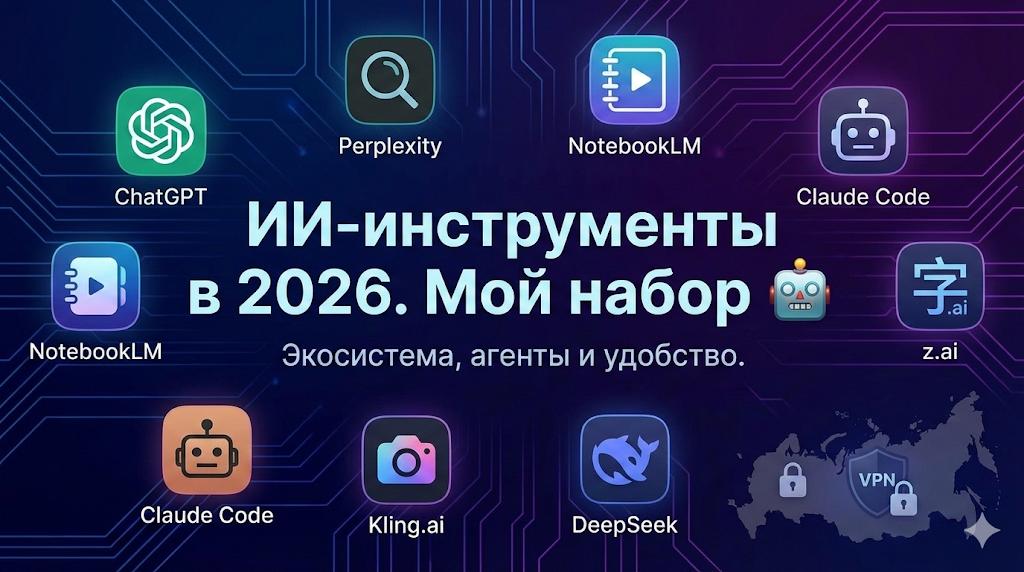
The landscape of artificial intelligence has evolved significantly over the past few years, shifting from revolutionary breakthroughs to a focus on ecosystems and seamless integration into daily life and work. As of now, various AI tools are becoming staples in our routines, and here’s a look at some essential ones that are making waves in 2026.
One of the foundational tools is ChatGPT, which I utilize in both its paid and free versions. While I experimented with Claude for text generation, I found it slower and less effective for my needs.
Perplexity has emerged as my primary resource for real-time internet searches, excelling in providing answers along with source links and deep research capabilities. Coupled with NotebookLM, this combination has become my favorite for learning and processing information. NotebookLM's ability to work exclusively with uploaded documents reduces noise and enhances clarity, allowing me to quickly generate high-quality outputs like mind maps, audio podcasts, presentations, video presentations, and infographics—all for free and with impressive quality.
For visuals and presentations, I often turn to Midjourney, ChatGPT, and Google Gemini, despite the hurdles of accessing Google with a VPN. The quality of images and infographics produced is outstanding, making the effort worthwhile.
In the realm of coding, I rely on Cursor alongside Claude Code, where I have developed my Telegram bot, @voice2textio_bot, to convert my chaotic thoughts into coherent text that I use daily. Recently, I switched to z.ai after discovering a generous sale on their subscriptions at just $28 for a year, which is a steal, even though such promotions may not be available now. This tool is particularly beneficial as it functions without a VPN from Russia.
For video content creation, I use Kling.ai, HeyGen, and OpusClip, with OpusClip being a reliable option despite the challenges similar to those faced with Google.
Interestingly, Russian AI models have significantly improved over the past year. GigaChat from Sberbank and Yandex's AI assistant, Alisa, are now formidable players. Meanwhile, Chinese models like DeepSeek and z.ai are aggressively expanding their offerings. Open-source options like qwen.ai are also notable, with tools like T-Lite and T-Pro being built on its framework.
The variety of available tools is vast, and their quality for everyday chat communication is quite comparable. As the market continues to grow, the competition intensifies, pushing developers to innovate and improve their offerings. This evolution indicates a promising future for users who will benefit from enhanced AI capabilities in their daily tasks.
Informational material. 18+.