
The European Space Agency (ESA) has launched an initiative called Embodied Intelligence for Autonomous Space Systems aimed at creating a new generation of fully autonomous space robots. This program invites researchers and companies to propose technologies that will enable robots to perceive their surroundings, make decisions, and execute tasks independently, without constant commands from Earth.
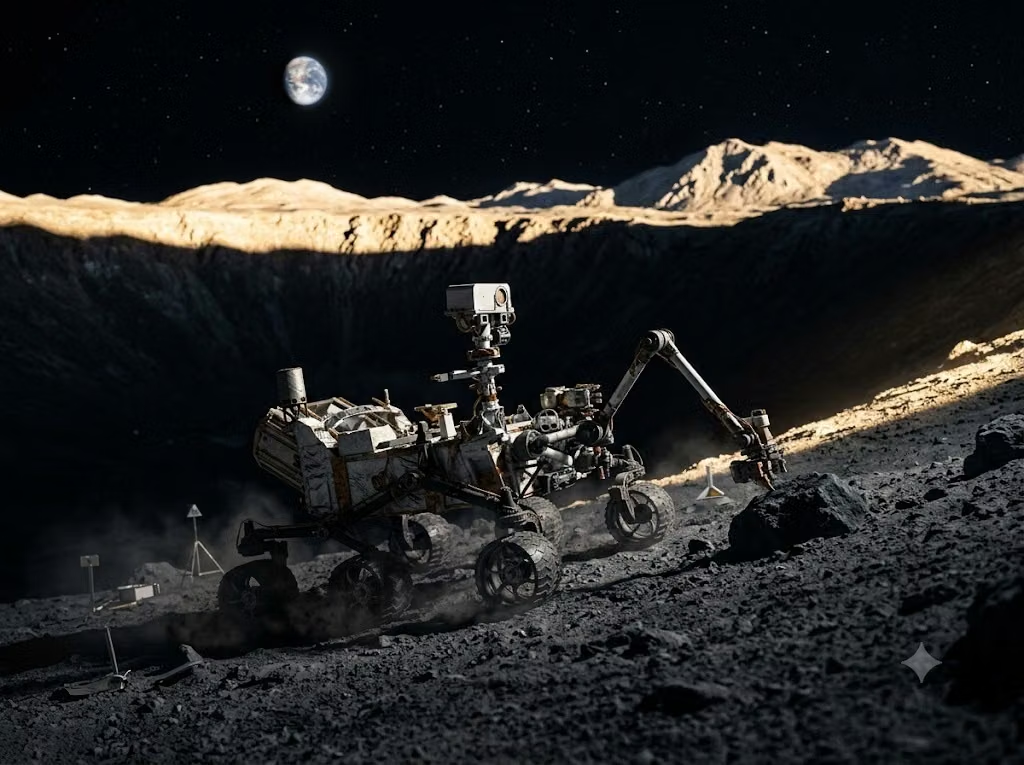
Traditionally, space robots are designed to perform pre-programmed actions or receive instructions from Earth-based operators. However, future missions may take place in environments where such communication is not feasible. For instance, a rover operating in a permanently shadowed lunar crater would be unable to quickly receive instructions due to a lack of direct communication and would need to analyze its environment and choose its next steps autonomously.
"Autonomy in space is not just about adding more artificial intelligence components to a robot. It's about creating integrated systems that can understand their environment, make informed decisions, and act effectively under the constraints of space missions, including limited power, computational resources, and connectivity," stated Lisa Denzer, head of ESA's AI Lab.
ESA has identified three key areas where these technologies are crucial. The first is autonomous exploration, which includes lengthy scientific journeys, examining permanently shadowed regions of the Moon, and independently locating interesting objects on the surface. The second area focuses on in-situ resource utilization (ISRU), involving the identification and extraction of lunar regolith and coordinating groups of specialized robots to build infrastructure. The third area pertains to supporting human presence for extended periods, where robots would assist astronauts, maintain equipment, and operate safely alongside humans.
To achieve these objectives, ESA is considering two complementary approaches. The first is called embodied co-design, which entails the simultaneous development of the robot's physical structure and its "intelligent system," ensuring that the body shape, sensors, and actuators are designed together with the software.
The second approach is termed physical intelligence, which involves leveraging new artificial intelligence methods, including planetary base models, environmental models, and interacting robot systems. These technologies are expected to help the robots adapt to unfamiliar conditions rather than just executing pre-defined scenarios.
According to Luis Mansilla, an AI systems engineer at ESA, the program is intended to lay the groundwork for the technologies required under the ESA Technology and Strategy 2040 plan. The agency notes that upcoming missions aimed at exploring and utilizing resources from celestial bodies will demand a higher level of autonomy than currently existing systems provide.
The idea submission process is divided into two phases. Initially, ESA will evaluate the innovativeness of the proposals and their differentiation from existing technologies. The deadline for submissions is set for August 10. Authors of the most promising concepts will have the opportunity to develop full projects, with evaluations expected in October.
Selected initiatives may receive funding through ESA's Discovery and Preparation programs, which support research involving graduate students and postdoctoral researchers, early technology development, and preliminary studies for future missions.
ESA emphasizes that this program is not aimed at developing individual artificial intelligence algorithms or automating specific functions. Instead, the agency is seeking comprehensive architectures for autonomous systems that can explore the lunar and planetary surfaces, allowing robots to perceive their environment, make decisions, and operate effectively under limited communication with Earth.
This initiative could significantly enhance ESA's capabilities in space exploration, setting a new standard for autonomy that may challenge competitors in the field of space robotics.
Informational material. 18+.