
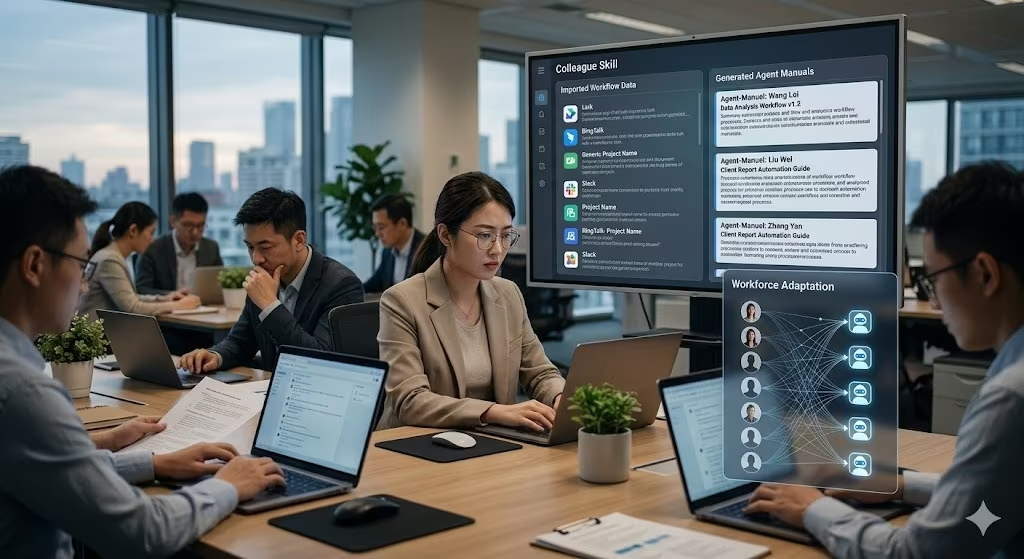
In a surprising trend, Chinese IT professionals are increasingly being asked to train artificial intelligence systems based on their colleagues' work processes. This practice, which began as an experiment and a joke, has swiftly become integrated into corporate routines, sparking debates about whether automation is ultimately replacing human employees. At the heart of this discussion is the viral GitHub project known as Colleague Skill. The creators claim that this tool can distill the skills and personal traits of coworkers to create AI agents that mimic them. Originally intended as satire, the project quickly gained traction on Chinese social media, capturing the attention of IT workers and managers alike.
According to reports, employees at various companies have been instructed to document their workflows to facilitate automation through AI agents like OpenClaw or Claude Code. While the official narrative promotes efficiency, the underlying goal appears to be the creation of detailed instructions from which a digital twin of an employee can be developed. Colleague Skill operates by allowing users to input a colleague's name and basic profile information, after which the system automatically imports communication histories and work files from corporate applications. The result is a comprehensive guide detailing an individual's responsibilities, work style, and even behavioral quirks, such as punctuation habits, which can then be imitated by an AI agent.
User reactions have been mixed, with some finding humor in the idea of "automating colleagues before automating themselves." However, many employees have expressed concerns about the threat to their professional identity and the implications for labor dignity in the age of AI. Amber Li, a 27-year-old IT specialist from Shanghai, shared her experience using Colleague Skill to recreate a former colleague. She reported that the system produced a detailed profile of how that person completed their tasks, including nuanced behavioral traits. While she found the AI agent helpful for coding assistance, she described the experience as "creepy and uncomfortable."
Simultaneously, there is a growing trend in China toward integrating AI agents into workplace processes. Companies are urging employees to create detailed "work maps" to bridge the gap between AI capabilities and actual business tasks. Although these systems can read news articles, summarize documents, respond to emails, and book services, employees claim their effectiveness in a corporate environment remains limited and requires constant oversight.
Hancheng Cao, an associate professor at Emory University, offers a pragmatic perspective on this practice. Companies not only gain experience with AI tools but also acquire structured data on how their employees work. This insight helps identify processes that can be standardized and areas where human decision-making remains crucial. Nevertheless, employees perceive this trend differently. One anonymous engineer voiced concerns that training AI based on their workflows reduces their work to modular tasks that are easier to automate.
In response to this trend, counter-projects have emerged. Koki Xu, an AI product manager from Beijing, launched an "anti-distillation" tool on GitHub designed to hinder the creation of such work models. Depending on the level of "sabotage," the system transforms job descriptions into overly generalized and non-automatable text. A video demonstrating this project has garnered over 5 million likes.
Xu, who has a legal background, raises important questions about the ownership of data that describes an employee's thought processes and behavioral traits—whether it belongs to the company or the individual. She hopes that discussions surrounding Colleague Skill will lead to new approaches for protecting professional identity in the era of AI.
Despite these developments, many employees do not view their jobs as immediately replaceable. Amber Li emphasizes that her company cannot rely on AI agents yet due to their instability. "I don't think my job is at risk right now. But I feel its value is diminishing, and I'm unsure how to address that," she remarked. This situation highlights the complex landscape of AI integration in the workplace, raising questions for both the market and competitors regarding the future of human roles and the evolving nature of work.
Informational material. 18+.