

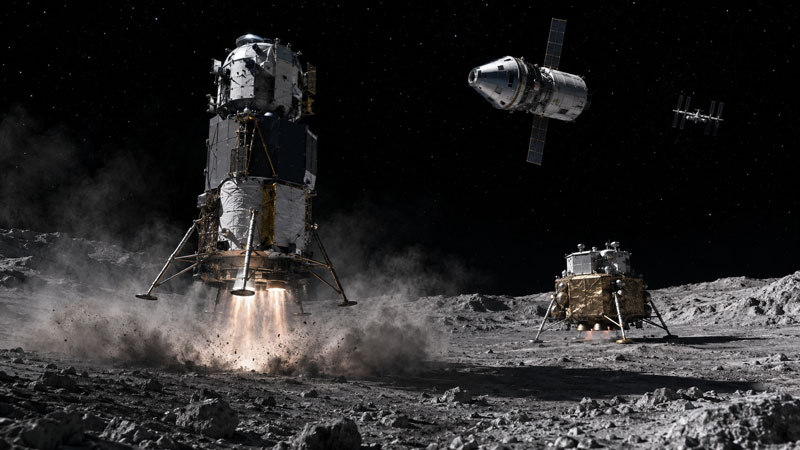
Chinese engineers have announced that their upcoming lunar module, named Lanyue, boasts reliability that far exceeds that of American models, which are still under development. This assertion comes from a recent publication in a specialized journal focusing on space technology. The Lanyue module is designed to enhance crew survival during lunar landings, addressing safety concerns that plagued the Apollo missions over fifty years ago. The Apollo landers relied on a single engine for ascent, presenting a grave risk should it fail. In contrast, Lanyue is equipped with multiple engines, ensuring a higher level of safety for astronauts.
Engineers have created an innovative design for the Lanyue module, featuring a shared fuel and oxidizer tank separated by a partition. This design allows for the installation of four adjustable thruster engines without exceeding weight limitations. The redundancy built into the system means that if one engine fails, the module can still successfully launch from the lunar surface. In fact, it is capable of taking off even with one or two of its main engines compromised, significantly increasing its survivability.
When compared to the Apollo landing modules, the Lanyue represents a new standard in reliability. However, the final configurations of the upcoming Artemis program's landers remain unknown, making direct comparisons challenging. NASA plans to utilize modules from SpaceX and Blue Origin, which will incorporate multiple engines, though both designs come with their own risks. SpaceX's Starship is expected to feature at least six engines, while Blue Origin's Blue Moon Mark 2 will have a minimum of three. Yet, Blue Origin is currently facing significant challenges that may affect its module's future.
The advancement of the Lanyue module indicates a competitive edge in the ongoing lunar race, particularly as NASA’s Artemis program progresses. This could reshape the landscape for future lunar exploration, prompting competitors to reassess their designs and safety protocols in light of China's ambitious plans.
Informational material. 18+.