

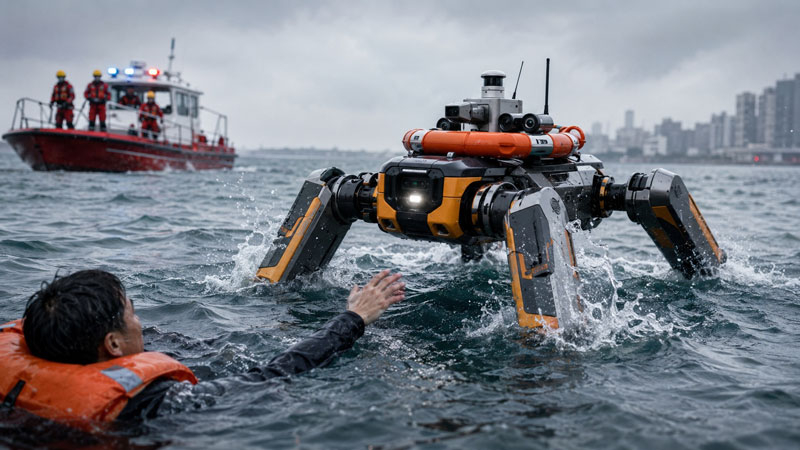
A new groundbreaking drone, named QuadBoat, has been unveiled by researchers at the Shenzhen Institute of Artificial Intelligence and Robotics for Society, in collaboration with the Chinese University of Hong Kong and the Stevens Institute of Technology in the United States. This innovative unmanned aerial vehicle is designed to rescue drowning individuals and is inspired by the water-walking capabilities of the spider-like water strider.
Traditional rescue devices often provide support to keep drowning victims afloat until help arrives, which proves insufficient in cold water scenarios where individuals can lose consciousness quickly. The QuadBoat addresses this issue by autonomously navigating to the victim, lifting them from the water, and transporting them safely to shore or to a rescue vessel.
The QuadBoat is a quadrimaran, featuring a central platform supported by four floats, which also function as movable "legs" equipped with propeller-driven motors. Each leg has four degrees of freedom, allowing it to adjust its position and height relative to the water's surface. This design enables the QuadBoat to alter its width from 1.188 to 1.85 meters and its height from 0.425 to 0.643 meters. The prototype weighs in at 25 kilograms, can reach speeds of up to 0.8 meters per second, carries a payload of 20 kilograms, and operates for approximately two hours on a single charge.
Control of the drone employs a cascade scheme, where a model predictive controller (MPC) determines the main body movement, while individual controllers manage the speed and movement of each leg. At its core is a Raspberry Pi 4B computer with an ARM Cortex-A72 processor, and other components are controlled by Arduino Nano boards. Power is supplied by a 12-volt lithium-ion battery with a capacity of 58,800 mAh. Additionally, a camera on board identifies targets and assesses their positions, maintaining communication with a shore-based computer through a wireless local network.
The QuadBoat has undergone testing in both a 6x6 meter pool and open water environments. During trials, it successfully adjusted its legs to navigate through openings as narrow as 1.1 meters and maneuvered under obstacles. However, the initial rescue attempts yielded mixed results: the drone was able to "rescue" mannequins in the pool 70% of the time, but this dropped to 50% success in open water conditions, with average task completion times of 116 and 132 seconds, respectively.
Currently, the QuadBoat remains an early prototype. Its payload capacity is insufficient for adult-sized individuals, and its performance is hindered by environmental factors such as wind, waves, and sunlight reflections on the water. Researchers acknowledge that further development is necessary.
This advancement in drone technology could significantly impact the lifesaving market, providing new solutions for emergency responders and potentially prompting competitors to innovate in similar rescue technologies.
Informational material. 18+.