

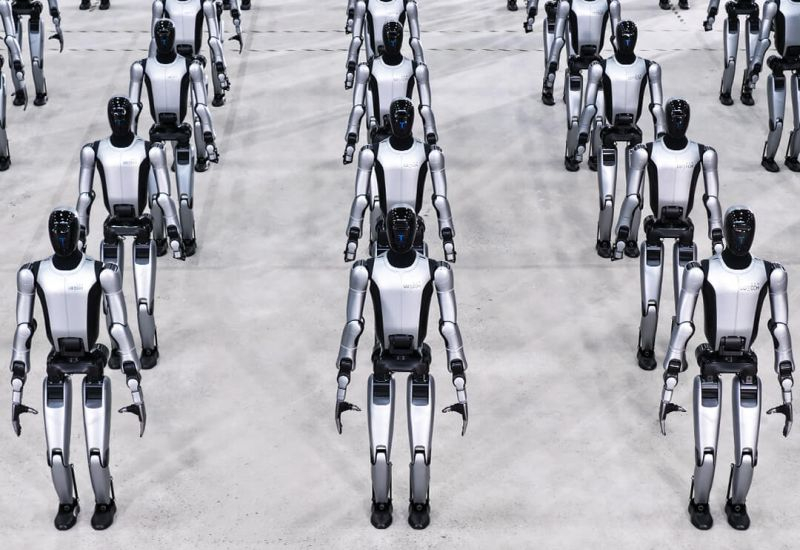
The anticipated breakthrough in humanoid robotics, often compared to the impact of ChatGPT since its launch in late 2022, may still be a decade away, according to experts in the field. While the technology has made significant strides, industry leaders caution that a true leap forward will require extensive data and advancements in training methodologies. At a recent conference, Wang Xiaogang, chairman of Daxiao Robotics, suggested that a pivotal moment could arise in just a few years through the scaling of data and the use of modeling and simulation. He emphasized the importance of leveraging digital twins to enhance robotics capabilities, a sentiment echoed by Jensen Huang, founder of Nvidia.
Shao Hao, head of robotics at Vivo, offered a more conservative estimate, predicting a breakthrough in humanoid robots might still be around ten years away. He noted that the primary challenge lies in the lack of affordable, real-world data necessary for training robots to navigate the complexities of daily life. Experts agree that advancements will not be instantaneous; rather, the industry will evolve gradually, achieving incremental improvements across various applications.
Recent demonstrations by Chinese developers showcased the remarkable choreography and acrobatics of humanoid robots during a nationwide New Year concert. However, these performances were tightly controlled and relied heavily on pre-programmed movements rather than real-time adaptability. For robots to function confidently in everyday environments, extensive training remains necessary. The availability of affordable data for this training is seen as a potential bottleneck for the entire robotics sector.
Additionally, challenges remain regarding the kinetic abilities of robots, including issues of stability and reliability. Public perception and trust in robots working alongside humans also need to be addressed. Former New Zealand Prime Minister Jenny Shipley highlighted the importance of setting standards for safety and social policy as robots begin to replace human workers in various professions.
Singapore has started to develop regulatory frameworks for AI agents, setting an example that the robotics industry may follow. Shipley expressed concerns about the lack of clarity in the management and accountability of AI technologies, warning that uncontrolled adoption could lead to social and economic upheaval.
This slow progression in humanoid robotics indicates that while the market is evolving, competitors must focus on refining their technologies and addressing public concerns to remain relevant in an increasingly competitive landscape.
Informational material. 18+.