
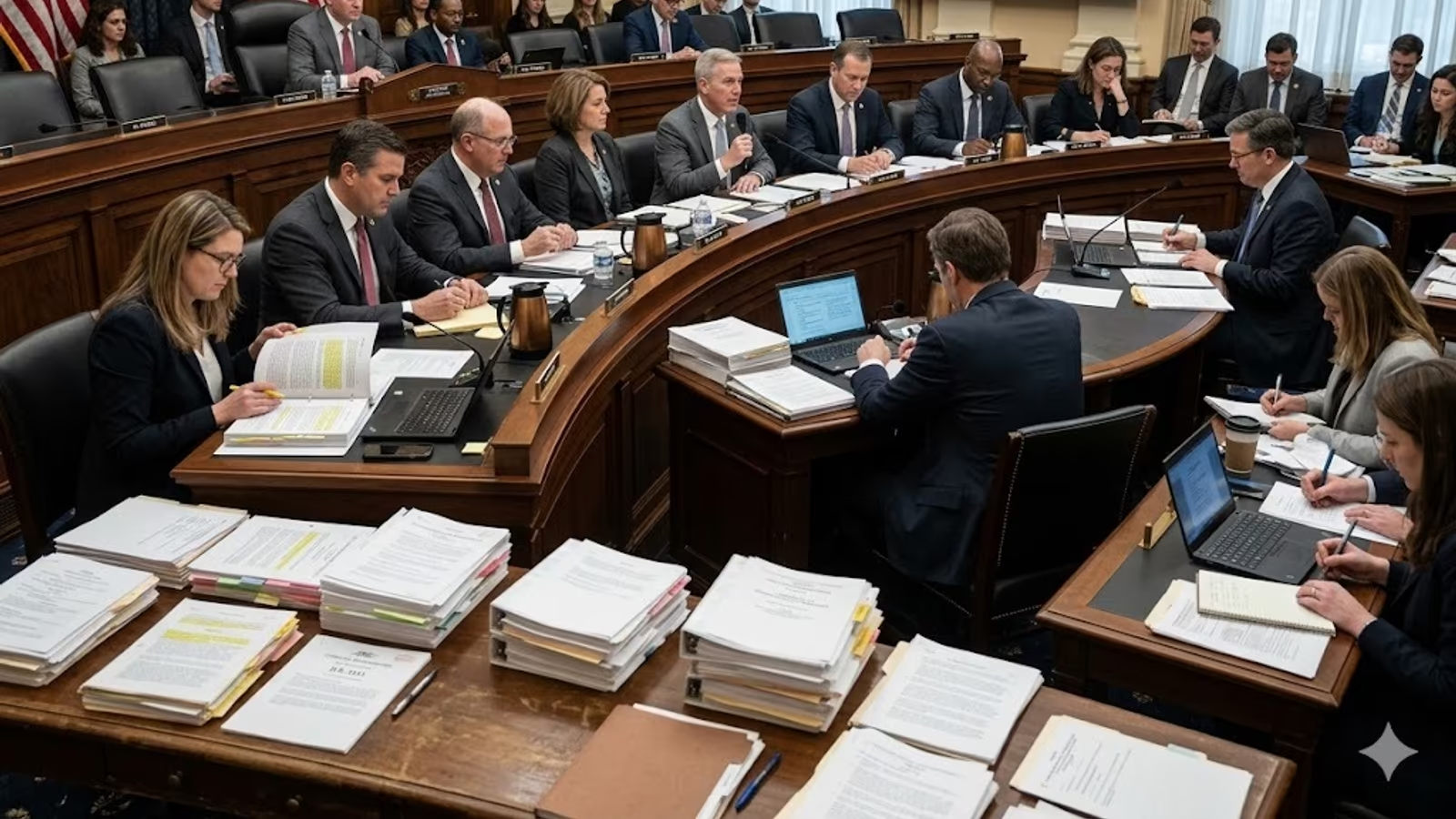
A new bipartisan bill has been introduced in the United States, seeking to establish a federal regulatory framework for advanced artificial intelligence models. Titled the Great American AI Act, the proposal has been made public for discussion by Republican Congressman Jay Obernolte and Democratic Congresswoman Lori Trahan.
The legislation mandates that developers of "advanced" AI models—defined as the most powerful and complex systems—must regularly report their development processes to federal authorities. Additionally, companies will be required to create plans to mitigate significant risks, including cybersecurity threats, and allow for external audits to ensure compliance with these stipulations.
A central feature of the initiative is the establishment of the Center for AI Standards and Innovation (CAISI), which will be housed within the National Institute of Standards and Technology (NIST) under the Department of Commerce. CAISI is expected to assess advanced models over a three-year period, although its proposed funding of $300 million needs separate Congressional approval.
This initiative is presented as an effort to create a cohesive federal approach to AI regulation. However, one of the most contentious aspects of the bill is the provision that could allow for the limitation or repeal of certain existing state laws. This involves a "federal preemption mechanism," which could enable national regulations to override local standards.
The bill has garnered support from various lawmakers across party lines, including Democrats Suhas Subramanyam and Scott Peters, along with Republicans Scott Franklin and Erin Houchin.
Despite this bipartisan backing, the proposal has drawn significant criticism from civil rights and advocacy groups. Public Citizen labeled the initiative as "dangerous," arguing that it overlooks critical risks such as algorithmic discrimination, fraud, the impact of AI on teenagers, and the spread of deepfakes, while weakening existing regional protections.
Critics further contend that the bill might inadvertently bolster the positions of major tech companies like OpenAI, Meta, Google, and Anthropic, as a federal system could replace stricter regulations already enacted at the state level.
In response, proponents of the bill indicated that it is open to revisions and is intended to gather expert and public input before its official introduction. They emphasize the goal of creating a unified regulatory framework that protects citizens without stifling industry growth.
Polls conducted by advocacy groups reveal that a substantial portion of voters in the districts of the bill's sponsors are skeptical about the idea of loosening regional AI regulations. However, the final form of the legislation remains uncertain, as it is currently under discussion and may undergo significant changes before being presented to Congress.
This legislative move could reshape the AI regulatory landscape, impacting market dynamics and potentially favoring larger tech firms over smaller competitors in the industry.
Informational material. 18+.