

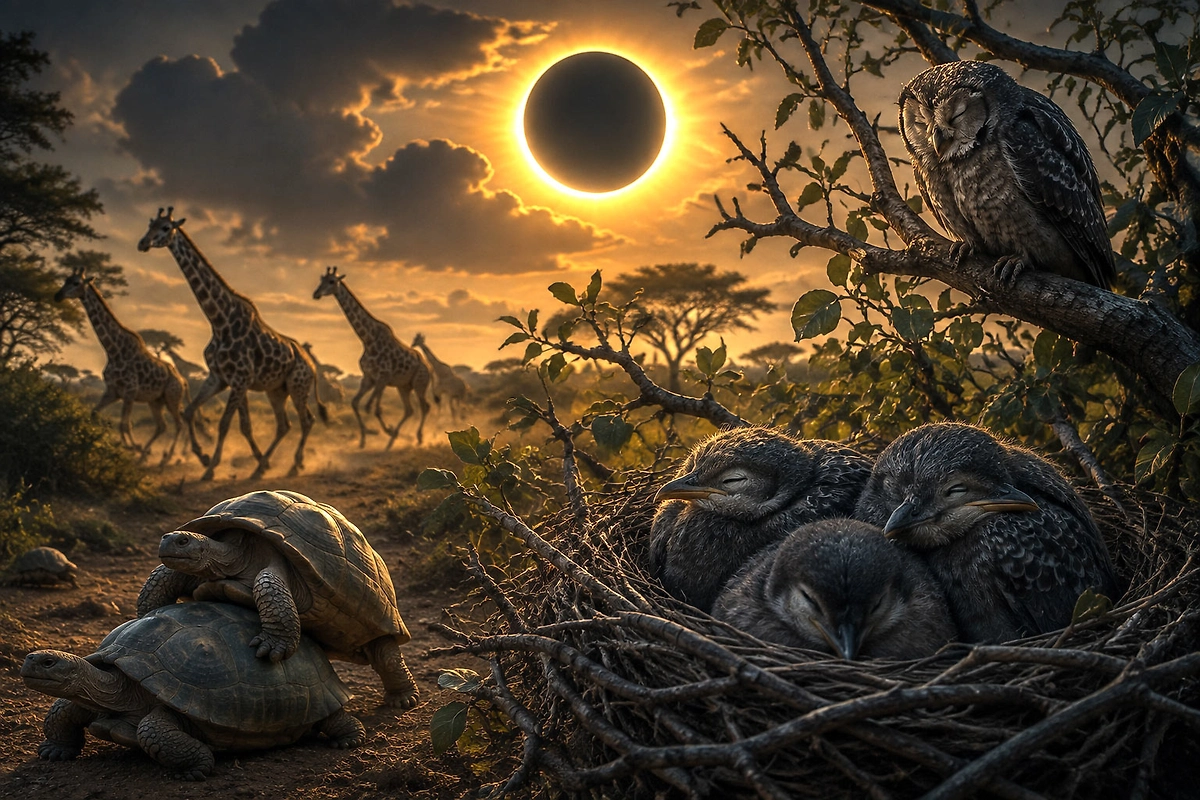
On August 12, a solar eclipse will occur, and while humans prepare to observe the celestial event, animals will showcase their unique responses. As the moon obscures the sun, nature appears to hit a “night mode” button, causing daytime birds to rush to their nests, bees to halt their flights, and crickets to start chirping. Observations over nearly a century have revealed that these sudden changes in light can disrupt the daily routines of various species.
During the total solar eclipse on August 12, 2026, the path of totality will sweep across northern Russia, Greenland, Iceland, northern Spain, and a small section of Portugal, while the rest of Europe will witness a partial eclipse. As people seek the best viewing spots and prepare their eclipse glasses, animals will react differently. Some may perceive the abrupt darkness as the onset of night, prompting them to seek shelter, while others may remain indifferent to the event.
Research has shown that many animals' activities are closely tied to light levels, with daylight signaling feeding times, nesting, hunting, and sleeping. During a total eclipse, the abrupt transition into darkness can lead to a variety of behaviors. Daytime creatures may cease activity and prepare for night, while nocturnal animals might become active. However, the return of sunlight can confuse many, leading to a swift shift back to daytime behaviors.
A notable study conducted at Riverbanks Zoo in South Carolina during the 2017 eclipse observed 17 species and found that 76% exhibited behavioral changes. Common responses included retreating to nighttime accommodations or displaying signs of anxiety. For instance, gorillas lined up to return to their indoor quarters, while giraffes huddled together and exhibited signs of distress, such as pacing. Other animals, like flamingos, displayed protective behaviors towards their young.
In a surprising twist, Galápagos tortoises, typically slow-moving, became notably active during the eclipse, with some even engaging in mating behaviors. While this response was unique and not necessarily indicative of a universal pattern among reptiles, it highlighted how eclipse conditions can temporarily alter animal behavior.
However, not all animals reacted with alarm. A recent study during a 2024 eclipse indicated a calmer response, with certain species, such as zebras, showing increased activity and mild stress. This suggests that reactions can vary widely depending on species, individual temperament, and environmental factors.
Birds, in particular, exhibit fascinating responses to eclipses. Many daytime birds may stop singing and lower their activity levels, while nocturnal species might awaken. Once the sun reappears, birds often resume their normal routines as if a second dawn has occurred.
As the solar eclipse approaches, understanding these animal behaviors provides insight into the interconnectedness of light and life in the animal kingdom. For the market and competitors, this highlights the importance of considering animal welfare and natural behaviors in wildlife tourism and conservation efforts during such events.
Informational material. 18+.