
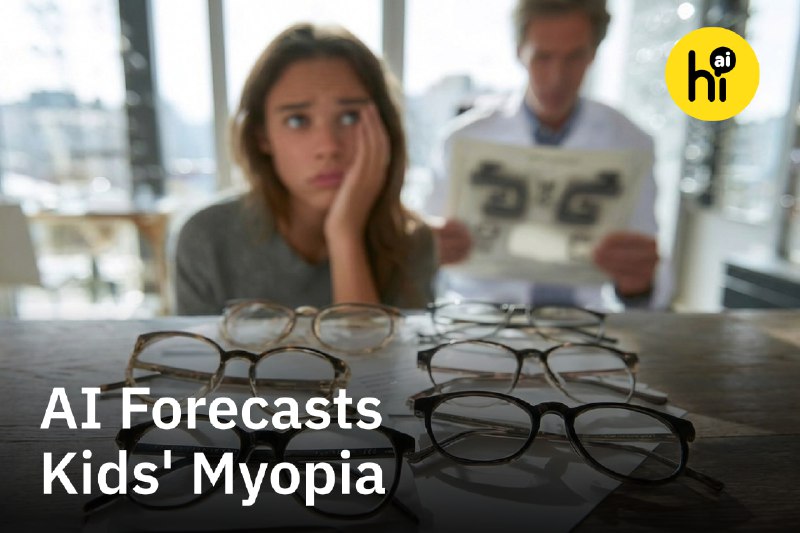
A team of researchers in China has developed a neural network capable of predicting the advancement of nearsightedness, or myopia, several years ahead of time. This innovative model was trained using retinal images from over 3,000 schoolchildren who participated in annual eye examinations over a span of five years. The AI system demonstrates impressive capabilities, achieving an accuracy rate of 86% in determining whether a child's vision will deteriorate. Furthermore, it can predict the likelihood of developing high myopia, defined as -6.0 diopters or worse, with a striking accuracy of 98%. It also estimates what an individual’s eyeglass prescription might be over the next one to five years. The accuracy of long-term predictions varies with the time frame: for instance, the average error for a one-year forecast is just ±0.37 diopters, while a five-year prediction has a margin of error of about ±1.1 diopters. Remarkably, if the AI is provided with images taken over multiple years instead of relying on a single image, the error margin decreases to approximately ±0.32 diopters, which is roughly equivalent to one step in prescription strength. The significance of this development cannot be overstated, as myopia is increasingly prevalent among adolescents. Rapid declines in vision can result in severe complications, including glaucoma, retinal detachment, and potential blindness. By forecasting changes in vision years in advance, healthcare professionals can better identify patients who may require closer observation to prevent long-term harm.
Informational material. 18+.