
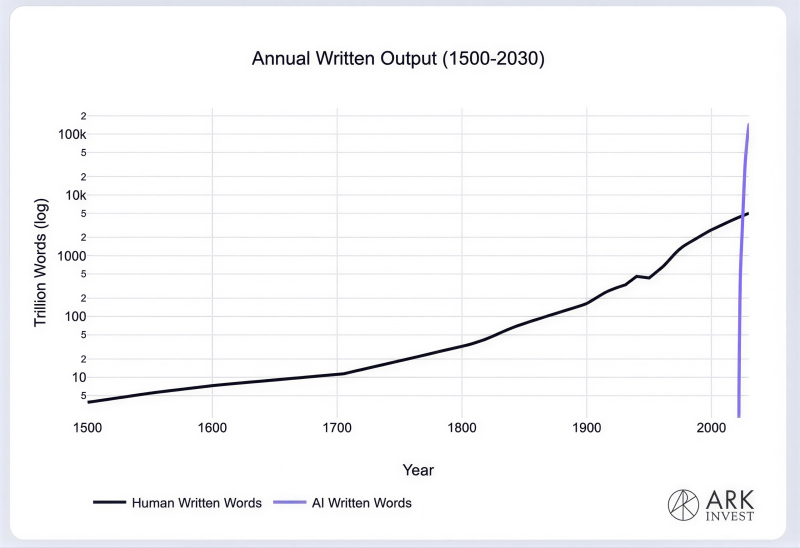
In a groundbreaking revelation, recent research from ARK Invest shows that the total number of words generated by artificial intelligence (AI) in 2025 exceeded the entirety of human-written content for that year, hitting a staggering 200 trillion words. This exponential growth suggests that by the end of the decade, AI-generated text could surpass all human writings throughout history, even if one includes ancient scripts yet to be deciphered. The implications of this technological leap are profound, raising questions about the nature of creativity and the role of machines in cultural production.
March saw notable advancements in AI applications across various sectors. A heartwarming story emerged from Washington Post about a dog, lost for two months, reunited with its owner thanks to the AI-powered Petco Love Lost database, which has helped over 200,000 pets find their homes since 2021. In the realm of software, Greg Kroah-Hartman, a prominent figure in Linux development, praised AI's role in identifying coding bugs, stating that the integration of AI in open-source projects has revolutionized code verification.
Moreover, innovative projects were unveiled, such as smart wheelchairs developed by the German Research Center for Artificial Intelligence, designed to navigate complex environments autonomously. Meanwhile, British company Automated Architecture introduced robotic "portable factories" utilizing AI to construct wooden building frameworks, claiming their services are 30% cheaper than traditional labor.
However, the rise of AI is not without its critiques. A study from Foxit and Sapio Research indicated that while 89% of executives feel more productive with AI tools, actual time savings are modest, with employees spending significant time verifying AI outputs. Concerns about emotional dependence on chatbots and declining social interactions were also highlighted in this research.
As AI continues to evolve and integrate into various industries, the competition among tech firms intensifies, pushing them to innovate faster or risk falling behind. The increasing reliance on AI for tasks once reserved for humans could reshape job markets and redefine productivity standards across sectors.
Informational material. 18+.